Categories
blog

Interview with Jacob Mundy in “El Watan,” leading Algerian francophone daily

«Le Maroc semble incapable de gouverner sans la violence»
A la une International
Professeur Jacob Mundy. Spécialiste du Sahara occidental à Colgate University
le 21.05.13
Zine Cherfaoui

Le peuple sahraoui a célébré, hier, le 40e anniversaire du déclenchement de sa lutte armée contre l’occupation marocaine, après avoir commémoré, le 10 mai courant, la création du Front Polisario (10 mai 1973). Spécialiste du conflit, Jacob Mundy, actuellement professeur à Colgate University (New York), décrypte pour nous les enjeux de la dernière réunion du Conseil de sécurité de l’ONU consacrée au dossier sahraoui. Celui-ci (le Conseil de sécurité) a, rappelle-t-on, adopté le 25 avril dernier la résolution 2099 dans laquelle il a réitéré son appel à «une solution politique juste et durable acceptée par les deux parties et qui garantit le droit du peuple sahraoui à l’autodétermination».

-Comment expliquez-vous le regain d’intérêt du gouvernement américain pour le conflit du Sahara occidental ces derniers temps ?

Ce regain d’intérêt américain est probablement dû au nouveau secrétaire d’Etat américain, John Kerry. Ce dernier soutient le droit du peuple sahraoui à l’autodétermination depuis de nombreuses années. C’est son collègue, le regretté sénateur Edward Kennedy, qui l’a sensibilisé sur la question du Sahara occidental après qu’il soit lui-même devenu sénateur de l’Etat du Massachusetts. Kennedy a été l’un des premiers sénateurs à soutenir le droit du Sahara occidental à l’indépendance.

L’ancienne secrétaire d’Etat américaine, Hillary Clinton, comme chacun le sait, est plus complaisante à l’égard du Maroc pour des raisons personnelles et politiques. Sans Hillary Clinton, la représentante américaine aux Nations unies, Susan Rice, qui est également favorable à la lutte du Sahara occidental, aura désormais plus de liberté au Conseil de sécurité de l’ONU pour faire pression afin d’obtenir l’élargissement à la surveillance des droits humains du mandat de la Mission des Nations unies pour l’organisation d’un référendum au Sahara occidental (Minurso).

-Quelle est exactement, aujourd’hui, la position des Etats-Unis sur le conflit au Sahara occidental et quels sont les éléments qui contribuent à la définir ?

Si les parties en conflit, c’est-à-dire le Maroc et le Polisario, s’entendent sur un projet d’autonomie, les Etats-Unis vont soutenir. Si celles-ci conviennent d’un référendum sur l’indépendance, Washington va également soutenir. Les Etats-Unis aimeraient voir le conflit du Sahara occidental connaître une solution juridique qui respecte l’autodétermination. Toutefois, l’autodétermination n’a jamais été la priorité de la Maison-Blanche. En revanche, un Maghreb stable constitue la priorité des Etats-Unis. Dans les conditions actuelles, toute solution au conflit du Sahara occidental doit être acceptée par tous du point de vue de Washington.

Les Etats-Unis feront toujours le choix du statu quo en premier dans le cas où une solution menacerait de déstabiliser la région. Ils ne soutiendront donc pas une solution imposée aux parties. L’ancien émissaire de l’ONU, James Baker, avait par exemple souhaité voir le Conseil de sécurité imposer sa solution au Maroc. La Maison-Blanche avait toutefois rejeté l’idée. Inversement, le Maroc, en 2007, voulait imposer sa proposition «d’autonomie» pour le Sahara occidental. La suite tout le monde la connaît : le gouvernement américain l’a rejetée et a choisi la voie des négociations en soutenant la nomination de l’ambassadeur actuel, Christopher Ross. Cette attitude (politique) est déterminée par un intérêt historique : celui de voir s’établir un gouvernement stable à l’embouchure de la Méditerranée. Comme avec l’Egypte, la priorité américaine au Maroc n’est pas le régime en tant que tel mais la stabilité que le régime offre. Toutes les autres considérations, y compris l’Algérie et ses ressources énergétiques, sont secondaires.

-Avant la dernière réunion du Conseil de sécurité de l’ONU sur le Sahara occidental (25 avril 2013), les Etats-Unis ont présenté un projet de résolution appelant à élargir le mandat de la Minurso à la surveillance des droits de l’homme dans les territoires sahraouis occupés. Washington a fini par se rétracter à la dernière minute. Qu’est-ce qui explique ce changement d’attitude ?

Les Etats-Unis ont voulu envoyer un signal au Maroc, mais pas au prix de perdre la présence de l’ONU au Sahara occidental. Un veto français aurait mis fin, en effet, à l’existence de la Minurso. Ce n’est dans l’intérêt de personne que cela se produise. Sur la question du Sahara occidental, le Conseil de sécurité utilise le consensus pour adopter des résolutions sur la Minurso. Il y a eu quelques exceptions à cette règle. La dernière en date remonte à février 2000, lorsque les Etats-Unis et la France ont abandonné le processus référendaire pour protéger le nouveau roi, Mohammed VI. Avec un vote, il n’aurait pas pu gagner. Cela fut une réunion du Conseil de sécurité très controversée.

-Pourquoi, d’après-vous, la France s’oppose à la surveillance des droits humains au Sahara occidental?

Si elles avaient obtenu l’élargissement des prérogatives de la Minurso, les Nations unies auraient eu largement la possibilité de documenter les violations quotidiennes des droits humains par le Maroc. C’est la raison pour laquelle la France s’oppose à la surveillance des droits humains au Sahara occidental. Le Maroc semble être incapable de gouverner le Sahara occidental sans l’usage de la violence, la peur et le contrôle de la société. Le suivi régulier des droits de l’homme conduirait nécessairement à une intervention plus importante de l’ONU (envoi par exemple de rapporteurs spéciaux sur la torture et les exécutions sommaires). Des poursuites de la CPI pourraient même être envisagées.
-Avant qu’elle ne change, la proposition américaine a donné des sueurs froides au Maroc. C’est probablement la première fois que les Etats-Unis mettent en difficulté leur allié traditionnel dans la région. Qu’est-ce qui explique la montée au créneau de Washington ? Les Etats-Unis sont-ils en train de revoir leur politique maghrébine ?

Non, il ne s’agit pas d’une révision radicale de la politique américaine à l’égard du Maghreb ou du Sahara occidental. Sous l’Administration Obama, les Etats-Unis n’ont cessé d’exercer des pressions sur le Conseil de sécurité pour qu’il élargisse le mandat de la Minurso à la surveillance des droits de l’homme. Les Etats-Unis ont souvent rappelé à l’ordre Rabat concernant les violations des droits de l’homme. Mais cela s’est toujours fait avec beaucoup de discrétion. En avril 2013, cela a changé. Depuis 2003 (plan Baker), c’est effectivement la première fois que les Etats-Unis s’opposent ouvertement au Maroc. Mais dans les deux cas, Washington tentait en réalité de pousser le Maroc à gagner les cœurs et les esprits des Sahraouis.

-A votre avis, pourquoi le Maroc ne veut pas entendre parler d’un référendum d’autodétermination au Sahara occidental ?

Du plus petit village du Haut-Atlas jusque dans les rues de Casablanca, il est difficile de trouver une divergence d’opinions sur la question du Sahara occidental. En privé, les Marocains remettent en question les «lignes rouges» traditionnelles de la société (la monarchie, l’islam, l’armée, etc.), mais pratiquement aucun ne remet en cause la question du Sahara occidental. C’est un accomplissement incroyable de l’idéologie nationaliste ! La plus grande victime de cette idéologie est le roi lui-même.

-Comment ça ?

Il est dit quelque part que les rois sont les pions de l’histoire. Personnellement, je pense que Mohammed VI est le pion d’une histoire qu’il n’a pas écrite. Il doit suivre l’histoire que son défunt père, le roi Hassan II, lui a léguée. Celle-ci ressemble beaucoup à la tragédie d’Hamlet. Mohammed VI subit. Il est gouverné par des fantômes. A l’inverse, Hassan II a été brutal mais respecté. Même les dirigeants du Polisario pourraient dire : nous aurions pu travailler avec Hassan II mais pas avec ce nouveau roi et son régime. La raison est que Hassan II a obtenu son trône en survivant à des moments très difficiles et en prenant le Sahara occidental de l’Espagne. En somme, seul Hassan II a pu prendre le Sahara occidental et donc lui seul aurait pu le rendre. Mohammed VI n’a pas pris le Sahara occidental. Il n’a donc pas le droit de le rendre. Plus de trois décennies après, le Sahara occidental est devenu la chasse gardée de puissants intérêts dans l’armée et le makhzen. Le fait aujourd’hui que la pêche et l’exploitation des phosphates soient très rentables n’incite pas le Maroc à abandonner ce territoire.

-Comment voyez-vous l’évolution du conflit ?

Dans mon livre et sur le site web de Foreign Policy (Politique étrangère), j’ai soutenu que Washington n’interviendra dans le conflit du Sahara occidental que s’il devient une crise majeure et menace de déstabiliser le Maroc. Si, aujourd’hui, le Timor oriental est indépendant c’est parce que Bill Clinton a été forcé de faire un choix : permettre qu’un second génocide s’y produise ou dire à l’Indonésie de se retirer. Moubarak est parti parce qu’Obama a été aussi forcé de faire un choix, en particulier lorsque les travailleurs ont menacé de bloquer le canal de Suez. La même logique s’applique au Sahara occidental. Jusqu’à ce que les Etats-Unis soient obligés de faire un choix au Sahara occidental, ils choisiront toujours de ne pas choisir.
Categories
blog

Stephen Zunes remembers George McGovern, author of the foreword to Western Sahara: War, Nationalism, and Conflict Resolution

McGovern’s Progressive Leadership on Middle East Policy
By Stephen Zunes
October 22, 2012

Though a supporter of Israel’s right to exist, George McGovern also became an outspoken opponent of its human rights abuses.

Though former senator and 1972 Democratic presidential nominee George McGovern, who died Sunday at age 90, was best known for his opposition to the Vietnam War and his efforts in fighting world hunger, he also made a mark regarding U.S. Middle East policy.

Like many liberals of his generation, he had a strong attachment to Israel as the national homeland for the Jewish people returning to the lands of their forefathers to escape centuries of oppression. It was only later in his Senate career, in 1975, when asked by Foreign Relationship chairman J. William Fulbright to chair the Middle East subcommittee, did he learn about the plight of the Palestinians. He became a strong supporter of a two-state solution at a time when the Democratic Party was on record opposing Palestinian statehood and emerged as an outspoken opponent of Israeli human rights abuses and other violations of international law while maintaining his steadfast support for Israel’s right to exist in peace and security.

He emphasized that, as a friend of Israel, he was obliged to do what a real friend must do when they see someone behaving in ways that are both immoral and threaten their own self-interest: tell them to stop.

His support for international law and self-determination was rooted in his taking part in the war on fascism. In his foreword to my most recent book, which analyzes the Moroccan occupation of Western Sahara, he noted how that experience helped teach him that the right of self-determination “is one of the most fundamental rights of all” and that “no government should get away with denying that right by invading, occupying and annexing another national and oppressing its people.” He faulted successive administrations of both parties for failing to uphold such fundamental principles of international law.

His interest in Middle Eastern affairs led him to become president of the Middle East Policy Council in 1991, a non-profit group based in Washington addressing political, economic and security issues in the region impacting the United States. In a 1993 interview I did with him for The Progressive magazine which took place while we were both visiting Damascus, he observed, “What I’m picking up now in my travels is a feeling that… a new form of imperialism is now operating in the Middle East. We may not have any colonies as did previous Western powers, but there is a belief that many of the ruling regimes are somehow tied in to the West in a way that does not enhance the well-being of the ordinary citizen. I think we’re headed for trouble if that perception prevails, particularly since there is a lot of truth behind it.”

He presciently added, “These Arab regimes are going to have to become more sensitive to the problems of their own people. This is what this Muslim extremism is all about: It’s a kind of desperate move by people who do not know how to get the attention of the ruling regimes any other way but to shake them up with extremist, radical, and sometimes violent methods.”

McGovern later became an outspoken critic of the Iraq War, comparing it to the tragedy of Vietnam. In 2006, he wrote Out of Iraq: A Practical Plan for Withdrawal Now, which helped a number of Democrats who had been too timid to speak out against the war previously to become bolder. In a Washington Post op-ed in January 2008, McGovern – arguing that “Nixon was bad [but] these guys are worse” – called for the impeachment of President Bush and Vice-president Cheney over their violations of the U.S. constitution and of national and international law, and their repeated lies to the American people. Speaker of the House and Democratic Congressional leader Nancy Pelosi, however, dismissed such calls for impeachment as “off the table.”

McGovern also expressed concern about the bipartisan threats of war against Iran and the hypocrisy in U.S. nonproliferation policy. In 2006, George and I wrote an op-ed for the San Jose Mercury News criticizing the Bush administration for signing a nuclear cooperation agreement with India. We argued, “How can we have any credibility in trying to block Iran’s nuclear program, which is still many years away from weapons capability, when we are supporting the nuclear program of a neighboring country which has already developed a dangerous nuclear arsenal? Maintaining such flagrant double-standards regarding nuclear proliferation is simply not worthy of a country which asserts the right to global leadership.”

It is disappointing to see so many of today’s otherwise liberal Democrats taking belligerent stances towards Iran and allying with Israel’s right-wing government by defending its occupation policies and other violations of international humanitarian law.

It is important to realize that McGovern – despite representing an under-populated state in the Great Plains – became such a prominent voice in foreign policy not just because of his many qualities, but because there were movements that magnified that voice. Ultimately, then, it is up to us to make possible the emergence of political leaders who will challenge both the Republicans and the Democratic establishment on the Middle East, as McGovern did on Southeast Asia.

Categories
blog

Divesting from All Occupations

In response to ongoing violations of international law and basic human rights by the rightist Israeli government of Benyamin Netanyahu in the occupied West Bank and elsewhere, there has been a growing call for divestment of stocks in corporations supporting the occupation.

Modeled after the largely successful divestment campaign in the 1980s against corporations doing business in apartheid South Africa, the movement targets companies that support the Israeli occupation by providing weapons or other instruments of repression to Israeli occupation forces, investing in or trading with enterprises in illegal Israeli settlements, and in other ways. Although human rights activists recognize such tactics as a legitimate form of nonviolent international solidarity with an oppressed people, right-wing groups supporting the occupation as well as some more moderate organizations concerned about the strident anti-Israel tone of some divestment supporters have denounced the movement.

Still, the campaign has scored notable successes. One target of the campaign has been the Caterpillar company, which has provided Israeli occupation forces with bulldozers that have illegally demolished thousands of Palestinian homes. In recent months, TIAA/CREF— the leading provider of retirement benefits for those in the academic, research, medical, and cultural fields—has removed Caterpillar from its Social Choice Fund. The influential Morgan Stanley Capital International has delisted Caterpillar from its World Socially Responsible Index, and the Quaker Friends Fiduciary Corporation has joined a growing list of groups which have divested stockholdings in the company. At the recent General Assembly of the Presbyterian Church USA, a resolution to divest from Caterpillar, along with Motorola and Hewlett Packard, for their complicity in the occupation was defeated by the narrowest of margins.
Opposing Occupation Everywhere

At the Presbyterian gathering and elsewhere, many opponents of the divestment resolution acknowledged that the Israeli government is engaged in serious human rights abuses in the occupied territories, but expressed concerned that the divestment resolution unfairly “singles out Israel.” Indeed, there are a number of governments in the world that engage in worse human rightsabuses than Israel, and violations of human rights should be opposed regardless if they take place within a country’s internationally-recognized borders or in an illegally occupied territory. Given that Israel is the world’s only Jewish state, there is understandably particular sensitivity if Israel alone is seen as being targeted, however serious the government’s transgressions.

However, there is a much stronger legal case for opposing human rights abuses in territories recognized as under foreign belligerent occupation. International law prohibits under most circumstances foreign companies from exploiting natural resources within such territories. Similarly, there are a host of legal issues regarding the export of weapons and other military resources to country’s that utilize them in suppressing the rights of those under occupation.

Indeed, these very issues were subjected to international debate during South Africa’s occupation of Namibia, Iraq’s occupation of Kuwait, and Indonesia’s occupation of East Timor.

Today, there are only three countries that are engaged in what the United Nations and the international community recognize as a foreign belligerent occupation: Israel, Morocco, and Armenia. (Although a moral case can be made for the independence of Tibet, Chechnya, and West Papua (as well as a number of other territories that aspire to become independent), the international community deems them as being within the internationally recognized borders of China, Russia and Indonesia respectively, and are therefore not recognized as occupied territories.)

Virtually no major international companies support Armenia’s current occupation of the small strip of Azerbaijan territory it controls. However, a number of companies support Morocco’s ongoing illegal occupation of the nation of Western Sahara.

U.S.-based Kosmos Energy is the only oil company in the world licensed for offshore oil exploration in the territorial waters of occupied Western Sahara. In 2002, a UN legal analysis determined that proceeding with such exploration activities would be in violation of international law. Similarly, two U.S. fertilizer companies – PCS and Mosaic – are major customers of Morocco’s illegal phosphate production in occupied Western Sahara. And, as is the case of the Israeli-occupied territories, U.S.-based arms manufacturers have supplied Moroccan occupation forces engaged in what independent human rights groups have described as gross and systematic human rights violations, including manufacturers of the teargas that has been used to break up peaceful demonstrations calling for the right of self-determination.
Expanding the Boycott

The Palestinian solidarity struggle would be considerably strengthened if, instead of calling for divestment specifically from companies supporting the Israeli occupation, the call was for divestment from companies supporting all foreign belligerent occupations.

Since it would effectively mean just one additional country and only a small number of companies, it would not take much attention away from the Israeli occupation and Western companies supporting the occupation. More importantly, it would help move the debate away from a divisive pro-Israel vs. anti-Israel dichotomy, where people often end up just talking past each other, to where the debate belongs: human rights and international law.

Morocco is a predominantly Arab Muslim country. By including Western Sahara along with Palestine, the movement would avoid the accusation that it is unfairly singling out Israel. After all, it would be targeting all illegal occupations, not just one.

Morocco, like Israel, is in violation of a series of United Nations Security Council resolutions and a landmark decision of the International Court of Justice regarding their occupation. Morocco, like Israel, has illegally moved tens of thousands of settlers into the occupied territory. Morocco, like Israel, engages in gross and systematic human rights abuses in the occupied territories. Morocco, like Israel, has illegally built a separation wall through the occupied territories. Morocco, like Israel, relies on the United States and other Western support to maintain the occupation by rendering the UN powerless to enforce international law. Morocco, like Israel, is able to maintain the occupation in part through the support of multinational corporations.

And just as Palestine is recognized by scores of countries and is a full member of the Arab League, Western Sahara is recognized by scores of countries and is a full member of the African Union, thereby insuring international support.

Not only would including all occupations in the divestment campaign help protect the movement from spurious charges of “anti-Semitism” and broaden its appeal, it would help bring attention to the little-known but important self-determination struggle of the Sahrawi people against the illegal and oppressive Moroccan occupation of their country, which was invaded by the U.S.-backed kingdom in 1975, eight years after the Israeli conquest of the West Bank and other Arab territories. (For a summary of the Western Sahara struggle and its implications, see Western Sahara: The Other Occupation)

Given the intense polarization, harsh polemics, and suspicions regarding Israel and Palestine, a campaign based more on universal legal and moral principles against occupation, rather than targeting a particular country that has a strong and influential domestic constituency, would be far more effective. Given the suffering of the Palestinian (and Sahrawi) peoples and the complicity of the U.S. government and U.S. corporations in their oppression, they deserve nothing less.

Categories
blog

London Review of Books: Gaddafi and Western Sahara

In his critique of the Nato intervention in Libya, Hugh Roberts spares a few moments for Gaddafi’s role in the politics of the Maghreb. I find it astonishing that he never mentions the disputed territory of the Western Sahara. Gaddafi was an early, erratic supporter of the Western Saharan liberation movement, Polisario, for reasons of his own, before Algeria backed their cause in 1975. Three decades later, Western Sahara is still a major obstacle to good relations between Rabat and Algiers. But Roberts circumvents the issue by asserting that Moroccan-Algerian relations have been hamstrung by territorial rivalry over neighbouring Mauritania. The gravel wastes of northern Mauritania, briefly contested in the 1970s, have little to do with the destructive conflict over a botched decolonisation of Western Sahara. Independence remains the key issue in this former Spanish colony, overrun by Morocco in 1975. Passionate in his opposition to the Nato assault on Gaddafi’s regime, Roberts is a stickler for international law. On Western Sahara, he has taken a realpolitik stance since the 1980s, unimpressed by the legitimacy of the Saharans’ case in the face of force majeure. So which is it to be, international law or realpolitik?

Jacob Mundy
Colgate University, Hamilton, New York

Categories
blog

The New York Times’ Western Sahara geography problem

Last week, the New York Times ran an article on Arab lobbying in Washington, DC. While the context of that article focused on the current uprisings in the Middle East and North Africa, the Western Sahara conflict received an indirect and odd mention.

Those of us who have followed the politics of the Western Sahara dispute have long known about Morocco’s multi-million dollar efforts to buy favor and sew fear through its lobbying in Washington. Unable to win hearts and minds in Western Sahara, Morocco has instead opted for many years to try to win over the White House, Congress and the defense-foreign affairs establishment.

What was odd about the NYT article was the way it framed the motive for Morocco’s efforts: ‘Morocco spent more than $3 million on Washington lobbyists, much of it aimed at gaining an edge in its border dispute with Algeria, while Algeria countered by spending $600,000 itself.’

As the blogger Kal at the Moor Next Door noted in a tweet, ‘Is Morocco also spending money on the New York Times? http://is.gd/1mErKT “border dispute w Algeria”? or, um, Western Sahara’.

While it is the case that there are some border issues between Morocco and Algeria (e.g., the land border has been closed for over a decade), there is no formal border dispute with Algeria. The international border between Morocco and Algeria is essentially recognized by both countries.

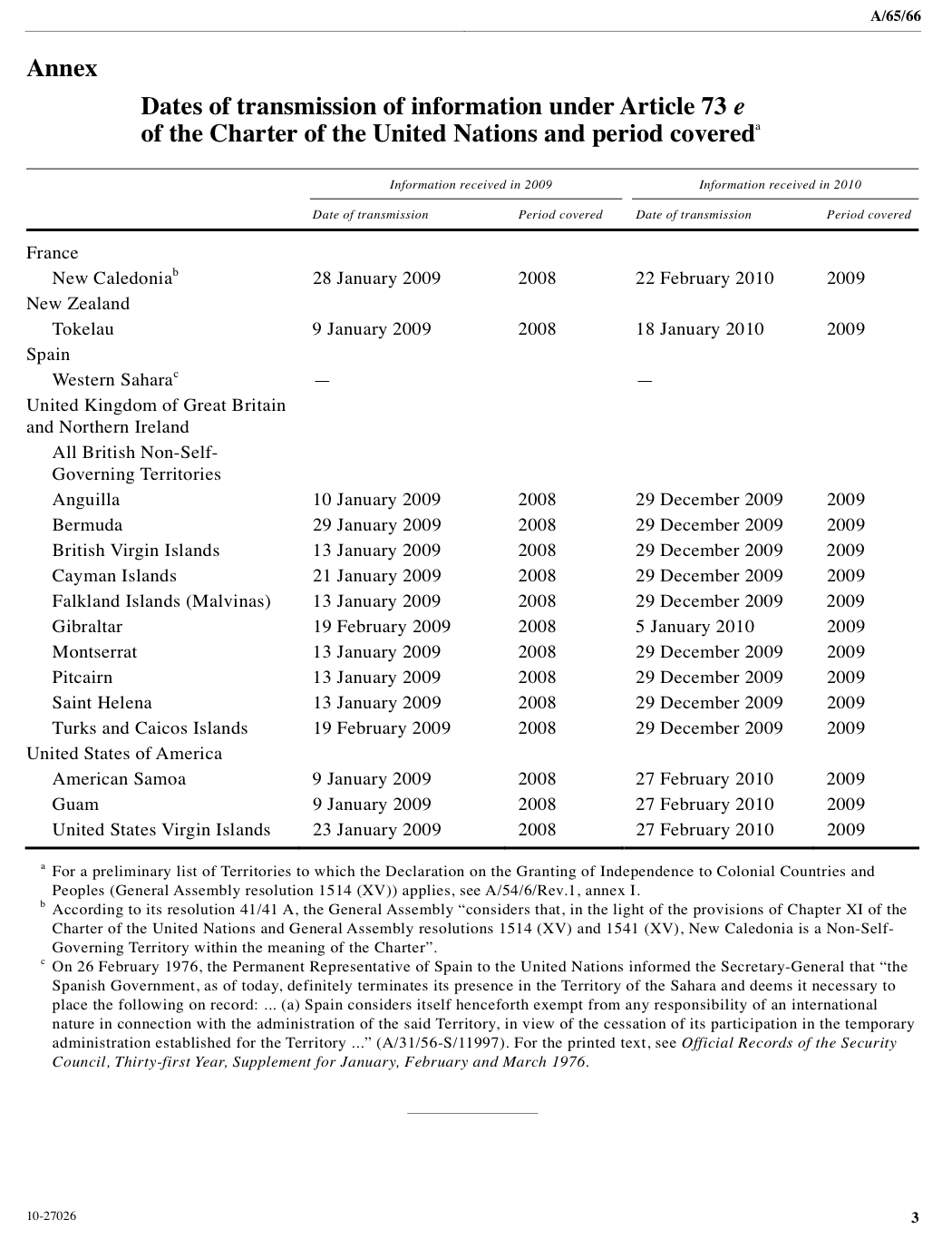
The ‘border dispute’ that motivates Morocco’s intense lobbying efforts in Washington, DC, is the dispute between Morocco and the rest of the international community over the territory of Western Sahara, which the United Nations considers a non-self-governing territory (read: a colony) still under Spanish de jure dominion.

In recent months, the NYT has had a difficult time grasping the fundamental geography of the Western Sahara conflict. Three times the US paper of record has described the Western Sahara conflict as ‘separatist’ or a case of ‘separatism’, often equating the issue with the recent secession of Southern Sudan (here, here and here). The last of the three elicited interesting letters from Human Rights Watch and Polisario.

Describing the Western Sahara conflict as a matter of separatism or as a separatist issue implies that Morocco has sovereignty or some kind of international legal authority over Western Sahara, which is clearly not the case.

In response to these articles, I wrote to the NYT’s ombudsman to ask what is their definition of separatism. This is what I got on 12 January 2011:

Dr. Mundy:

Thank you for writing and pointing this out to us. I’ve forwarded your email along to The Times editor who oversees corrections to see if this will warrant a correction. We’ve heard from a few other readers on this as well, so The Times is aware of this right now. Once again, thanks for writing. We appreciate your help.

Best,
Joseph Burgess
Office of the Public Editor
The New York Times
public@nytimes.com

On 24 January, I sent a follow up email to see if anything has been determined but no response yet.

Given the fact that the NYT can’t quite get the macro-geography of Western Sahara right, no surprise that two of its reporters, J. David Goodman and Souad Mekhennet, produced an alarmist article that made a stunningly basic mistake of Western Sahara micro-geography.

Its opening paragraph led with this frightening claim: ‘The Moroccan government arrested 27 people accused of operating a terrorist cell in Western Sahara led by a member of the local branch of Al Qaeda, officials said Wednesday’. Moroccan authorities, they reported, found arms caches in ‘three sites around Amgala’. (Reuters fell for it too.)

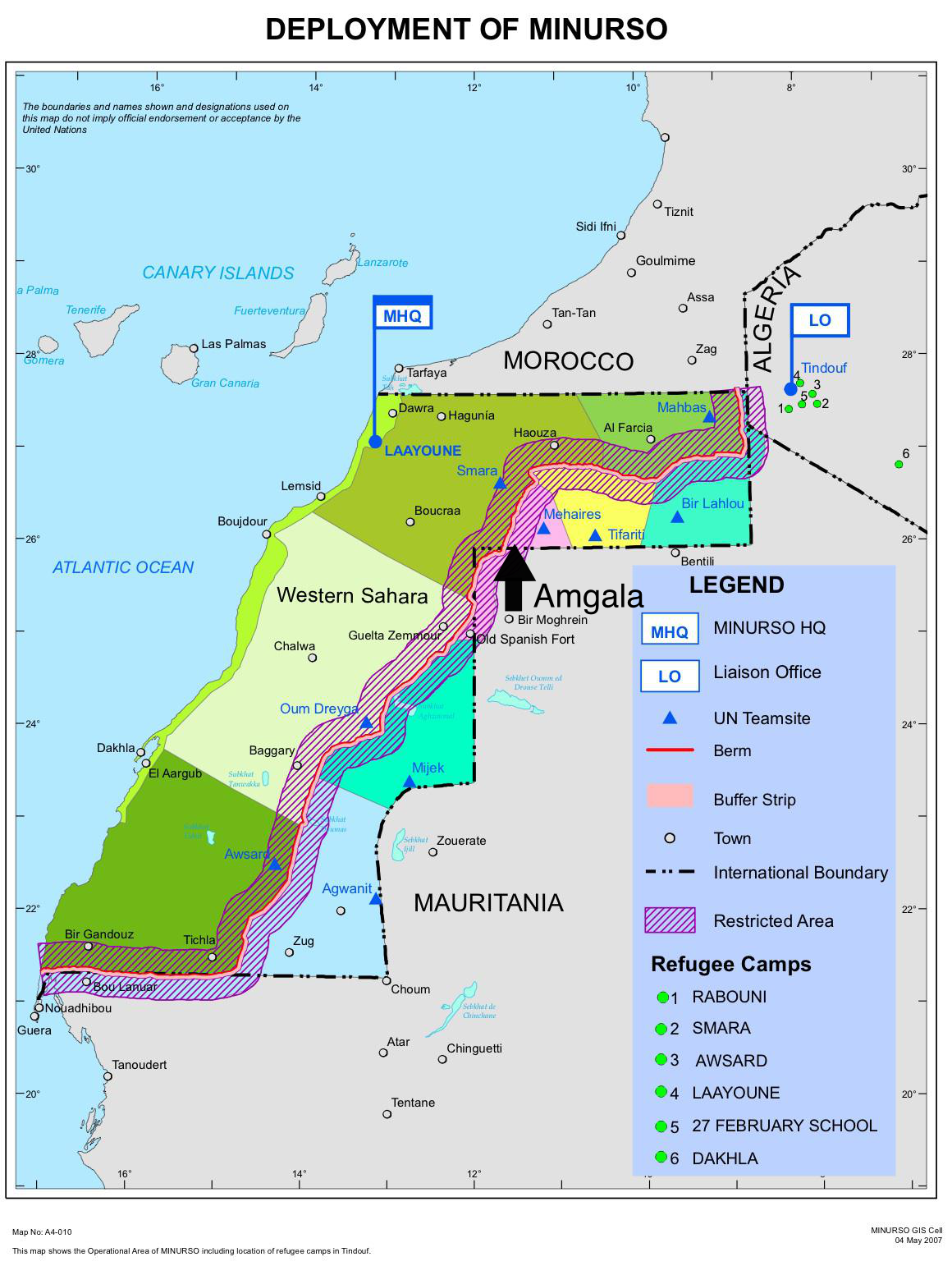
Two problems: The immediate problem is that Amgala is not under Moroccan control but rests within the buffer area east of Morocco’s defensive wall in Western Sahara. This area is strictly patrolled by the UN referendum mission in Western Sahara. Under the conditions of the cease-fire initiated by the United Nations in 1991, Morocco is prohibited from entering this buffer; Moroccan forces have not been able to enter the area of Amgala for twenty years. In short, someone is either stretching the meaning of ‘around’ (i.e., ‘around Amgala’) or there is something else going on. Minimally, one would expect the NYT reporters to pose this basic question to the UN mission. Instead, Goodman and Mekhennet seem satisfied repeating the Moroccan government view without any balancing opinions.

And this gets to the second problem: Given the fact that UN peacekeepers have been present in Western Sahara since the early 1990s, conducting constant patrols to monitor Moroccan and Polisario forces along the armistice line, and the fact that Morocco has some 100,000 reported troops in Western Sahara, how is it that AQIM seems to have such free reign in the Moroccan controlled Western Sahara?

In the wake of the massive demonstrations in Western Sahara in November, it is difficult not to think that Morocco simply wanted to scare Washington into thinking that Al-Qaida or AQIM had set up shop in the disputed Western Sahara.

Indeed, the eventual ‘reality’ of the Amgala affair was perhaps more telling than the NYT’s fiction. On 12 January, Reuters reported, ‘Morocco said five of its soldiers face trial for taking bribes from people smuggling weapons into an area of the disputed Western Sahara for a cell linked to al Qaeda in the Islamic Maghreb (AQIM).’

Did Goodman and Mekhennet write a follow up to their original piece? You must be joking.

But either way, Morocco wins: in the original narrative reported by the NYT, Polisario, through geographic insinuation, is tied to AQIM, and so Morocco seems like the side for Washington to back. In the revised narrative reported by Reuters, it seems that there are elements within Morocco’s military that are unknowingly aiding AQIM, which suggests that the US should redouble its cooperation with the Moroccan military to prevent its radicalization. How convenient that either narrative only supports one policy choice: choosing Morocco’s internal stability over the regional instability created by the Western Sahara conflict.

Categories
blog

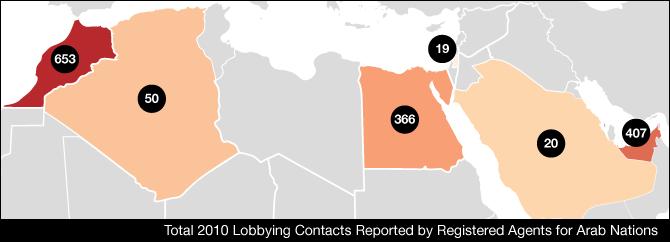
Thanks to Western Sahara, Morocco leads Arab world in number of US lobbying contracts

Read the rest at the Sunlight Foundation: http://sunlightfoundation.com/blog/2011/02/01/the-arab-worlds-2010-lobbying-contacts/

Categories
blog

WikiLeaks Cables on Western Sahara Show Role of Ideology in State Department

Over the years, as part of my academic research, I have spent many hours at the National Archives poring over diplomatic cables of the kind recently released by WikiLeaks. The only difference is that rather than being released after a 30+ year waiting period — when the principals involved are presumably dead or in retirement and the countries in question have very different governments in power — the WikiLeaks are a lot more recent, more relevant and, in some cases, more embarrassing as a result.

Categories
blog

Upsurge in repression challenges nonviolent resistance in Western Sahara

Sahrawis have engaged in protests, strikes, cultural celebrations, and other forms of civil resistance focused on such issues as educational policy, human rights, the release of political prisoners, and the right to self-determination. They have also raised the cost of occupation for the Moroccan government and increased the visibility of the Sahrawi cause.

Categories
blog

US leadership, not partisanship, desperately needed for peace in Western Sahara

[The following, coauthored with Anna Theofilopoulou, was sent to Foreign Policy magazine’s Middle East Channel blog in November 2010. It was written in response to a MEC posting by two lobbyists for Morocco (see below for links) who were responding to two earlier MEC posts by Theofilopoulou and me. MEC did not publish the response below nor did they respond to our subsequent emails. At roughly the same time, MEC did publish a response from Carne Ross, who lobbies for Polisario, the Western Sahara independence movement. – JM]

The past three days of violent confrontations between Moroccan security forces and Sahrawi protesters in the disputed Western Sahara clearly demonstrate the urgent need for the Security Council to take the issue more seriously before it spirals out of control. Initiative from the United States will be key to make this happen.

Recently we made the case for a more active US role in the Western Sahara peace process, prompting a constructive response from former US diplomats Ambassador Edward Gabriel and Mr Robert Holley, who now work as lobbyists for the Kingdom of Morocco. In their posting, Gabriel and Holley agree that a strong US role is needed but they claim that we are proposing a solution based on a referendum with independence as an option. Nowhere in our recent article or even the previous one posted in the Middle East Channel did we suggest such a thing.

Polisario and its supporters are quite capable of making the case for the independence option themselves.

There is a major point of difference between our approach and that of Gabriel and Holley: they back a partisan negotiation framework based upon Morocco’s 2007 autonomy solution. We, on the other hand, are advocating for a non-partisan approach, one that does not predetermine the meaning of sovereignty or self-determination before the parties get to the table. Essentially, we are saying that all the ingredients for a solution — final status, a referendum, power sharing, refugee repatriation, the role of Moroccan settlers, etc. — must be negotiated. With the guidance of the UN envoy, a more active US role, well-timed pressure from the UN Security Council and more imagination from the international community, we believe that Morocco and Polisario can piece together a comprehensive settlement that bridges their notions of sovereignty and self-determination.

Gabriel and Holley also present a questionable narrative of the peace process. They claim that the shift away from the integration/independence approach of the original 1991 UN Settlement Plan was initiated by the Clinton Administration and “was backed” by former Secretary of State James Baker, Personal Envoy of the Secretary-General to Western Sahara from 1997 to 2004. Those of us intimately involved with Baker’s work and internal happenings in the Western Sahara file at the United Nations beg to differ.

After watching the Western Sahara peace process stagnate for four years, the Clinton administration was more than happy to take a hands-off approach and let Baker do the heavy lifting. The Clinton White House fully backed his effort to implement the original Settlement Plan under the 1997 Houston Accords, which Baker had quickly negotiated between Morocco and Polisario. It was not until September 2000, in a meeting organized by Baker between the parties in Berlin, that the negotiations began to discuss other options besides the two choices of independence or integration. The impetus for this new direction, as everyone involved knows, was the fact that it had become abundantly clear that the referendum electorate would not favour integration with Morocco.

In Berlin, Baker asked Morocco if it would support a solution based upon some devolution of its governmental authority in Western Sahara. Though Morocco seemed willing, Rabat refused to discuss the issue of power sharing in a concrete or serious manner. This was especially the case after Baker proposed his own plan, at the prior request of the Security Council, in January 2003, a plan that included the option of independence. The US government then led effort in the UN Security Council to build support for Baker’s proposals in the summer of 2003. Only when it became clear that Morocco would no longer work with Baker did the George W. Bush administration, following the advice of Elliott Abrams, work with France and Spain to water down the Security Council’s support for the Baker Plan in April 2004.

After much coaxing, Morocco finally presented its autonomy proposal in 2007, which the Bush administration immediately deemed “serious and credible.” However, as an actual peace offer, its credibility and seriousness have to be reconciled against some hard facts that Polisario is well aware of. Morocco put it on the table because Abrams had suggested that formal US recognition of Moroccan sovereignty over Western Sahara would then be forthcoming. The State Department wisely derailed Abrams’ ambitions and helped run down the clock until the next administration. Now that Morocco is stuck with its autonomy proposal, Rabat has argued that Polisario must accept it on a take-it-or-leave-it basis.

Those of us with some historical memory can’t help but see this demand as a bit hypocritical. In 2003 and 2004, Morocco and its supporters in Washington and in the Security Council were working overtime to convince everyone that Baker could not force a solution to Western Sahara on either party — peace had to be the result of dialogue. Now Morocco wants the Security Council to force its 2007 autonomy solution, which precludes the option of independence, on Polisario.

To suggest that the negotiations over Western Sahara require such preconditions is neither true in theory nor in practice. As demonstrated in the parties’ rejections of the previous UN envoys (Morocco’s refusal to work with Baker, Polisario’s staunch refusal to accept Peter van Walsum), the neutrality of the UN Secretariat must be maintained. And since 2007, at the request of the Security Council the parties have been negotiating without any concrete preconditions. The paucity of results owes to the conflict’s apparent lack of urgency (prior to the events of the past two weeks). Western Sahara’s low strategic risk profile and negligible body count allows the UN to punt the issue every April when the UN mission comes up for renewal, passing vague and self-contradictory resolutions open to different interpretations by each party.

Just as there is a political stalemate in Western Sahara, there is also an intellectual stalemate. For too long, self-determination and sovereignty have been framed by the parties, their backers and, unfortunately, key mediators as diametrically opposed absolutes. This need not be the case. An honest broker will not accept the parties’ red lines as given but will attempt to find ways to transcend them.

In practice, self-determination and sovereignty can be seen as much more flexible than the discourse on Western Sahara often indicates. Very few countries have all of the attributes associated with claims of sovereignty; any state that has signed a treaty or entered into an agreement has already compromised its sovereignty. The realization of Morocco’s 2007 autonomy proposal would only prove the point.

In very few cases of decolonization were subject populations actually consulted in a formal referendum giving them the option of independence. By default rather than mandate, the international community has passively accepted independence as sufficient to achieve self-determination. It need not, however, been seen as necessary for self-determination. All that matters is whether or not the people of Western Sahara have the ultimate say when it comes to the final status of the territory.

About the authors

Anna Theofilopoulou covered Western Sahara and North Africa in the Department of Political Affairs of the United Nations from 1994 to 2006. She worked closely with former U.S. Secretary of State, James A. Baker, III throughout his appointment as Personal Envoy of the Secretary-General on Western Sahara.

Jacob Mundy holds a PhD from the University of Exeter’s Institute of Arab and Islamic Studies. He is coauthor of Western Sahara: War, Nationalism and Conflict Irresolution (Syracuse University Press).

Categories
blog

U.S. Middle East talks – a model for Western Sahara?

Coauthored with Anna Theofilopoulou

The recent decision by the Obama administration to invite Israel and the Palestinian Authority to engage in serious negotiations over the Middle East conflict should be instructive for those interested in resolving one that seems almost as intractable — the Western Sahara dispute. Key to this new effort in the Middle East conflict is (1) the U.S. is sponsoring and supporting the talks; (2) the U.S. has demanded that the two negotiate seriously, tackle the difficult subjects that have trounced previous attempts for resolution; and (3) the U.S. has given the two sides a one-year deadline. Though the fate of the Israel-Palestinian talks still hangs on a knife’s edge, a similar attitude on the part of United States towards the Western Sahara dispute might pave the way to a durable solution to one of Africa’s oldest conflicts.