Categories
blog

Stephen Zunes remembers George McGovern, author of the foreword to Western Sahara: War, Nationalism, and Conflict Resolution

McGovern’s Progressive Leadership on Middle East Policy
By Stephen Zunes
October 22, 2012

Though a supporter of Israel’s right to exist, George McGovern also became an outspoken opponent of its human rights abuses.

Though former senator and 1972 Democratic presidential nominee George McGovern, who died Sunday at age 90, was best known for his opposition to the Vietnam War and his efforts in fighting world hunger, he also made a mark regarding U.S. Middle East policy.

Like many liberals of his generation, he had a strong attachment to Israel as the national homeland for the Jewish people returning to the lands of their forefathers to escape centuries of oppression. It was only later in his Senate career, in 1975, when asked by Foreign Relationship chairman J. William Fulbright to chair the Middle East subcommittee, did he learn about the plight of the Palestinians. He became a strong supporter of a two-state solution at a time when the Democratic Party was on record opposing Palestinian statehood and emerged as an outspoken opponent of Israeli human rights abuses and other violations of international law while maintaining his steadfast support for Israel’s right to exist in peace and security.

He emphasized that, as a friend of Israel, he was obliged to do what a real friend must do when they see someone behaving in ways that are both immoral and threaten their own self-interest: tell them to stop.

His support for international law and self-determination was rooted in his taking part in the war on fascism. In his foreword to my most recent book, which analyzes the Moroccan occupation of Western Sahara, he noted how that experience helped teach him that the right of self-determination “is one of the most fundamental rights of all” and that “no government should get away with denying that right by invading, occupying and annexing another national and oppressing its people.” He faulted successive administrations of both parties for failing to uphold such fundamental principles of international law.

His interest in Middle Eastern affairs led him to become president of the Middle East Policy Council in 1991, a non-profit group based in Washington addressing political, economic and security issues in the region impacting the United States. In a 1993 interview I did with him for The Progressive magazine which took place while we were both visiting Damascus, he observed, “What I’m picking up now in my travels is a feeling that… a new form of imperialism is now operating in the Middle East. We may not have any colonies as did previous Western powers, but there is a belief that many of the ruling regimes are somehow tied in to the West in a way that does not enhance the well-being of the ordinary citizen. I think we’re headed for trouble if that perception prevails, particularly since there is a lot of truth behind it.”

He presciently added, “These Arab regimes are going to have to become more sensitive to the problems of their own people. This is what this Muslim extremism is all about: It’s a kind of desperate move by people who do not know how to get the attention of the ruling regimes any other way but to shake them up with extremist, radical, and sometimes violent methods.”

McGovern later became an outspoken critic of the Iraq War, comparing it to the tragedy of Vietnam. In 2006, he wrote Out of Iraq: A Practical Plan for Withdrawal Now, which helped a number of Democrats who had been too timid to speak out against the war previously to become bolder. In a Washington Post op-ed in January 2008, McGovern – arguing that “Nixon was bad [but] these guys are worse” – called for the impeachment of President Bush and Vice-president Cheney over their violations of the U.S. constitution and of national and international law, and their repeated lies to the American people. Speaker of the House and Democratic Congressional leader Nancy Pelosi, however, dismissed such calls for impeachment as “off the table.”

McGovern also expressed concern about the bipartisan threats of war against Iran and the hypocrisy in U.S. nonproliferation policy. In 2006, George and I wrote an op-ed for the San Jose Mercury News criticizing the Bush administration for signing a nuclear cooperation agreement with India. We argued, “How can we have any credibility in trying to block Iran’s nuclear program, which is still many years away from weapons capability, when we are supporting the nuclear program of a neighboring country which has already developed a dangerous nuclear arsenal? Maintaining such flagrant double-standards regarding nuclear proliferation is simply not worthy of a country which asserts the right to global leadership.”

It is disappointing to see so many of today’s otherwise liberal Democrats taking belligerent stances towards Iran and allying with Israel’s right-wing government by defending its occupation policies and other violations of international humanitarian law.

It is important to realize that McGovern – despite representing an under-populated state in the Great Plains – became such a prominent voice in foreign policy not just because of his many qualities, but because there were movements that magnified that voice. Ultimately, then, it is up to us to make possible the emergence of political leaders who will challenge both the Republicans and the Democratic establishment on the Middle East, as McGovern did on Southeast Asia.
Categories
blog

The Reality of Western Sahara : A rebuttal on accusations concerning the Polisario and Moroccan occupation

SAN FRANCISCO — Earlier this year, Global Post ran an article by Jordan Paul, executive director of the Moroccan American Center for Policy, a registered foreign agent for the Moroccan government, which funds, supervises, and coordinates the group’s activities. The article contained a series of demonstrably false claims attempting to rationalize for Morocco’s illegal occupation of its southern neighbor, the country of Western Sahara.

In 1975, the kingdom of Morocco conquered Western Sahara on the eve of its anticipated independence from Spain in defiance of a series of UN Security Council resolutions and a landmark 1975 decision by the International Court of Justice upholding the right of the country’s inhabitants to self-determination. With threats of a French and American veto at the UN preventing decisive action by the international community to stop the Moroccan invasion, the nationalist Polisario Front launched an armed struggle against the occupiers. The majority of the indigenous population, known as Sahrawis, went into exile, primarily in Polisario-run refugee camps in Algeria.

Thanks to U.S. and French military support for the conquering Moroccan forces, Morocco was able to hold on to most of Western Sahara. Yet the Polisario achieved a series of diplomatic victories that generated widespread international support for self-determination and opposition to the Moroccan takeover. In 1991, the Polisario agreed to a ceasefire in return for a Moroccan promise to allow for an internationally supervised referendum on the fate of the territory. Morocco, however, recognizing they would almost certainly lose such a plebiscite, refused to allow the scheduled vote to move forward.

French and American support for the Moroccan government blocked the UN Security Council from providing the necessary diplomatic pressure to force Morocco to allow the promised referendum to take place. The Polisario, meanwhile, recognizing its inability to defeat the Moroccans by military means, decided against resuming the armed struggle. As a result, the struggle for self-determination shifted to within the Moroccan-occupied territory, where the Sahrawi population has launched a nonviolent resistance campaign against the occupation, which – despite widespread Moroccan repression – has sporadically continued.

In an effort to justify their ongoing defiance of the international community for their illegal occupation, the autocratic Moroccan monarchy has redoubled its efforts to discredit their opponents, such hiring people like Paul to write articles like those that appeared in the Global Post in March.

Among Paul’s more bizarre claims is that the Polisario Front has links to Al-Qaeda in the Maghreb (AQIM.)

In reality, though Sahrawis are virtually all Muslims, they historically practice a decidedly liberal interpretation of the faith. The Polisario has since its founding been a secular organization, based on the belief that religious faith is between the individual and God, not a government or other temporal organization. Women have taken prominent positions in leadership. Meanwhile, radical Islamists in Algeria have condemned them for their secular ideology and even attacked Polisario offices.

Even during the twenty years of armed struggle, the Polisario never engaged in terrorism or any kind of deliberate attacks against civilian targets. And there has been none since.

Furthermore, the autocratic Algerian regime controls security around the refugee camps, which are located in the heavily-militarized region of Tindouf. After surviving a bloody decade-long civil war against Islamist extremists, the idea that the Algerian government would allow any group collaborating the AQIM to operate in such a sensitive area is pure fantasy.

While there are some legitimate concerns regarding some of the practices of the Polisario leadership in the camps, no credible independent analysts have documented Paul’s claims that the Polisario has been involved in “arms and drug trafficking, armed incursions into Mali, fighting as Gaddafi mercenaries in Libya, and kidnappings for AQIM in the Sahel.”

Contrary to Paul’s claim, the Polisario Front is not a “separatist” group. It is the ruling party of the nation of Western Sahara – known officially as the Sahrawi Arab Democratic Republic – which has been recognized by over 80 countries and is a full member state of the African Union. Western Sahara is recognized by the United Nations and virtually the entire international community as a non-self-governing country under foreign belligerent occupation.

And, contrary to Paul, the Polisario does not “force” the refugees to live in the camps. As someone who has visited both the camps and Moroccan-occupied parts of Western Sahara, it is clear that they are there to escape Moroccan repression in their occupied homeland, repression that has been well-documented by Amnesty International, Human Rights Watch, and other reputable human rights groups.

As with Indonesia’s occupation of East Timor, Israel’s occupation of the West Bank, and Iraq’s short-lived occupation of Kuwait, there are those who will try to justify illegitimate foreign occupations by making up such bizarre stories. However, it doesn’t mean they should be taken seriously.

http://www.globalpost.com/dispatches/news/regions/africa/morocco/the-reality-western-sahara

Stephen Zunes is a professor of Politics and chair or Middle Eastern Studies at the University of San Francisco. He is author, along with Jacob Mundy, of Western Sahara: War, Nationalism, and Conflict Irresolution (Syracuse University Press, 2010)

Categories
blog

The Western Sahara Peace Process: Tragedy or Farce?

At the end of every April, a small drama plays out in the UN Security Council. This is when the UN Mission for the Referendum in Western Sahara (MINURSO, its French acronym) comes up for its annual renewal. Western Sahara — Africa’s last colony according to the United Nations — is largely ignored by the Security Council the other eleven months of the year. The Secretary-General has a Person Envoy working on the case, former US Ambassador Christopher Ross, one of the great Arabophone diplomats of his age.  The mandate given to Ambassador Ross, to achieve a mutually acceptable political solution that will afford Western Sahara its long denied right to self-determination, is a farce and everyone knows it.

Morocco, the country that has illegally occupied Western Sahara since 1976, has made it abundantly clear that self-determination (that is, a referendum on independence) is out of the question. Backing Morocco’s unilateral assertion of sovereignty over Western Sahara is a member of the Permanent Five, France. What the United States is to Israeli interests on the Council, France is to Morocco’s. Even when Morocco does not hold a seat on the Council (as it will for the next two years), Paris and Rabat are thick as thieves when it comes to protecting Morocco’s control over Western Sahara.

By now it is well known that there is no will from the other permanent members of the Council to challenge France and Morocco on this issue. So every April Western Sahara’s “group of friends” (France, Russia, United States, United Kingdom, and Spain, the de jure administering power) comfortably assume their well established roles in the well scripted dramaturgy called the Western Sahara peace process.

For the native people of Western Sahara, who call themselves Sahrawis, the peace process has become a tragedy. Dispossessed of their homeland by Spain in 1885 and then Morocco nearly a hundred years later, the Western Saharan nationalist movement has found strong support in neighboring Algeria (Morocco’s regional adversary) and the African Union. That support, however, has its limits. Unlike East Timor, Western Sahara’s Asian twin in the annals of botched UN decolonizations, the Sahrawis remains under foreign domination or in exile. This year half the native population “celebrated” their thirty-seventh year in refugee camps in the roughest corner of the southwestern Algerian Sahara.

Sahrawi nationalists have become used to the cheap promises of the international community. Spain first promised a referendum on independence in 1974, prompting Morocco to invade the territory in 1975 right as Franco lay on his deathbed. As Moroccan and Western Saharan nationalist forces led by the Polisario Front waged war for Africa’s most sparsely inhabited desert territory, the Organization of African Unity (OAU), now known as the African Union, attempted to convince Morocco that a referendum was the only way out. After years of stalling by Rabat, the OAU decided to recognize Western Sahara as sovereign nation under the Saharan Arab Democratic Republic. The issue then moved to the UN Security Council where it lingers to this day.

First established in 1991, MINURSO was implemented to achieve one simple task: to organize a vote on independence (or integration with Morocco) for some 300,000 native Western Saharans. At the time, the King of Morocco, Hassan II, was nominally committed to a referendum on independence, so long as his “Sahrawis” were also allowed to vote. After eight years of painstaking technical negotiations and the tedious individual vetting of over 180,000 potential voters, MINURSO finally seemed ready to hold a referendum in the summer of 1999 — right when Hassan II died and the UN referendum in East Timor turned into a bloody fiasco. Morocco’s willingness to contemplate a referendum on independence died with Hassan II, as did the Security Council’s willingness to press the Moroccan regime towards a contentious and ambiguous end game without clear final status arrangements. This is when the language of a mutually acceptable political solution began to creep into the peace process.

At that time, James Baker, the former US Secretary of State, was in the driver’s seat of the negotiations. With the referendum on hold, Baker first attempted to work with Morocco to see what level of autonomy Rabat might be willing to grant Western Sahara. In principle, Morocco’s new leader, King Mohammed VI, was committed to devolving central authority to a quasi-independent Western Sahara, so long as ultimate sovereignty rested with him. In practice, the Moroccan negotiation team proved unwilling to consider even the most banal power-sharing arrangements.

Baker put forward a framework for discussion but his diplomatic blurring of the meaning of self-determination prompted a strong rejection from Polisario and Algeria. The Western Saharan independence movement has always insisted that any final status arrangement? be it integration, autonomy, or independence? had to be approved by the people of Western Sahara in a referendum. Algeria, thanks to its position in the global hydrocarbon market, wields enough influence to make sure that Polisario is listened to.  The Security Council surprisingly agreed with Polisario, urging Baker to find a mutually acceptable political solution that will provide for self-determination.

It is this language, which persists in UN Security Council resolutions on Western Sahara to date, that essentially gives both parties the ability to fire the person holding the position of the Secretary-General’s envoy. If Morocco feels that self-determination is being forced upon them, as they did when Baker put forward his final proposal in 2003, then they can stonewall in the name of a mutually agreed solution. If Polisario feels that self-determination is being undermined, then they can unilaterally declare no confidence in the Envoy and hope for a better hand next time. This is exactly what happened to Baker’s successor, Dutch diplomat Peter Van Walsum.

Not only is the Personal Envoy to Western Sahara expected to work miracles with an empty toolbox, the Secretariat has historically tolerated the parties’ unilateral rejection of the Envoy and members of the Security Council have failed to arm the Envoy with the means to get anything done.

This is the knife’s edge Ambassador Ross has walked since becoming the Personal Envoy in 2008. While Ross has managed to hold countless rounds of negotiations, there is apparently little to show for it. Polisario begrudgingly attends because they trust Ross, while Morocco’s “negotiating team” literally reads from a script prepared by the Palace from which they do not dare deviate from (thanks to the Interior Ministry minders watching over the Moroccan negotiators). For the past three years, both sides have mostly restated the positions they marked out in 2007: Morocco is willing to grant Western Sahara special regional status (an autonomy proposal that lacks all the legal hallmarks of genuine autonomy), while Polisario is willing to discuss post-referendum guarantees for a referendum that Morocco, and so too the Security Council, is unwilling to allow.

Today most of the debate surrounding the now routine renewal of the long moribund Western Sahara mission is not focused on MINURSO’s actual mandate (to hold a referendum). For several years, the major debate has been whether or not MINURSO should be allowed to monitor and report on human rights violations in the Moroccan occupied territory and the Polisario refugee camps in southwest Algeria. All other UN missions have this mandate, but morality and reason has its limits vis-à-vis French neocolonial interests. While the United States and United Kingdom (both ostensibly neutral in the dispute) favor the addition of human rights monitoring protocols to MINURSO’s mandate, their leverage over France is limited to one drastic threat: veto the renewal of MINURSO. As the presence of MINURSO — as is — is the key to maintaining a status quo Rabat and the Élysée see as beneficial, if sub-optimal; there appears to be some leverage to be gained from the veto (apart from any horse trading the Council members might do on other pet issues).

Last year the United States indeed is reported to have threatened to veto MINURSO to force Paris to acquiescence to human rights language in the April 2011 resolution. Washington got its way but with little to show for it. The 2012 draft report of the Secretary-General on Western Sahara (i.e., the initial draft written by MINURSO personnel in the territory) had little to say about human rights violations because Moroccan authorities systematically blocked the Mission from interacting with Sahrawis (as they have since blue helmets arrived in 1992).  In New York, Ban Ki-moon’s office and the peacekeeping department massaged these inconvenient truths out of the final public report that was released in April 2012 (as the Secretariat has done since 1992).

The warrant for including human rights language in the 2011 resolution came out of the first but largely forgotten uprising of the Arab Spring. In October and November 2010, thousands of Sahrawis attempted to re-occupy Western Sahara by setting up a protest camp outside of the territory’s largest city. A brutal Moroccan crackdown followed, resulting in several Sahrawian and Moroccan deaths. If mass violence is required for the Security Council to take a baby step towards expressing concern about human rights in Western Sahara, imagine what it will take for the Security Council to take MINURSO’s original mandate seriously.

Jacob Mundy is an Assistant Professor of Peace and Conflict Studies at Colgate University. He is coauthor with Stephen Zunes of Western Sahara: War, Nationalism, and Conflict Irresolution (Syracuse University Press), which went into its second printing in 2011. His current research in Libya, Sudan, and Algeria focuses on the relationship between the international response to mass atrocities and the global locations/allocations of energy resources.

http://www.e-ir.info/2012/05/10/the-western-sahara-peace-process-tragedy-or-farce/

Categories
blog

The New York Times’ Western Sahara geography problem

Last week, the New York Times ran an article on Arab lobbying in Washington, DC. While the context of that article focused on the current uprisings in the Middle East and North Africa, the Western Sahara conflict received an indirect and odd mention.

Those of us who have followed the politics of the Western Sahara dispute have long known about Morocco’s multi-million dollar efforts to buy favor and sew fear through its lobbying in Washington. Unable to win hearts and minds in Western Sahara, Morocco has instead opted for many years to try to win over the White House, Congress and the defense-foreign affairs establishment.

What was odd about the NYT article was the way it framed the motive for Morocco’s efforts: ‘Morocco spent more than $3 million on Washington lobbyists, much of it aimed at gaining an edge in its border dispute with Algeria, while Algeria countered by spending $600,000 itself.’

As the blogger Kal at the Moor Next Door noted in a tweet, ‘Is Morocco also spending money on the New York Times? http://is.gd/1mErKT “border dispute w Algeria”? or, um, Western Sahara’.

While it is the case that there are some border issues between Morocco and Algeria (e.g., the land border has been closed for over a decade), there is no formal border dispute with Algeria. The international border between Morocco and Algeria is essentially recognized by both countries.

The ‘border dispute’ that motivates Morocco’s intense lobbying efforts in Washington, DC, is the dispute between Morocco and the rest of the international community over the territory of Western Sahara, which the United Nations considers a non-self-governing territory (read: a colony) still under Spanish de jure dominion.

In recent months, the NYT has had a difficult time grasping the fundamental geography of the Western Sahara conflict. Three times the US paper of record has described the Western Sahara conflict as ‘separatist’ or a case of ‘separatism’, often equating the issue with the recent secession of Southern Sudan (here, here and here). The last of the three elicited interesting letters from Human Rights Watch and Polisario.

Describing the Western Sahara conflict as a matter of separatism or as a separatist issue implies that Morocco has sovereignty or some kind of international legal authority over Western Sahara, which is clearly not the case.

In response to these articles, I wrote to the NYT’s ombudsman to ask what is their definition of separatism. This is what I got on 12 January 2011:

Dr. Mundy:

Thank you for writing and pointing this out to us. I’ve forwarded your email along to The Times editor who oversees corrections to see if this will warrant a correction. We’ve heard from a few other readers on this as well, so The Times is aware of this right now. Once again, thanks for writing. We appreciate your help.

Best,
Joseph Burgess
Office of the Public Editor
The New York Times
public@nytimes.com

On 24 January, I sent a follow up email to see if anything has been determined but no response yet.

Given the fact that the NYT can’t quite get the macro-geography of Western Sahara right, no surprise that two of its reporters, J. David Goodman and Souad Mekhennet, produced an alarmist article that made a stunningly basic mistake of Western Sahara micro-geography.

Its opening paragraph led with this frightening claim: ‘The Moroccan government arrested 27 people accused of operating a terrorist cell in Western Sahara led by a member of the local branch of Al Qaeda, officials said Wednesday’. Moroccan authorities, they reported, found arms caches in ‘three sites around Amgala’. (Reuters fell for it too.)

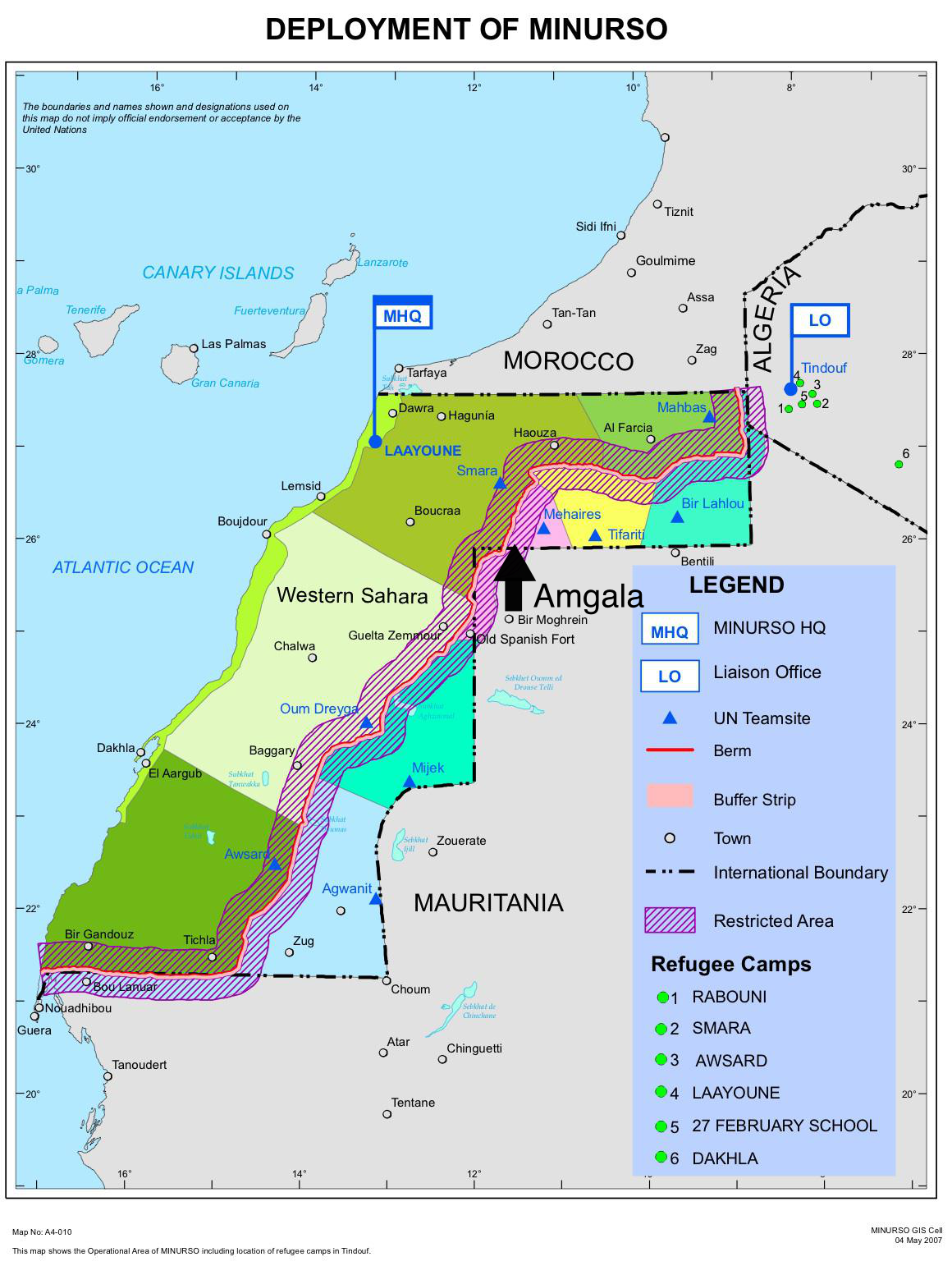
Two problems: The immediate problem is that Amgala is not under Moroccan control but rests within the buffer area east of Morocco’s defensive wall in Western Sahara. This area is strictly patrolled by the UN referendum mission in Western Sahara. Under the conditions of the cease-fire initiated by the United Nations in 1991, Morocco is prohibited from entering this buffer; Moroccan forces have not been able to enter the area of Amgala for twenty years. In short, someone is either stretching the meaning of ‘around’ (i.e., ‘around Amgala’) or there is something else going on. Minimally, one would expect the NYT reporters to pose this basic question to the UN mission. Instead, Goodman and Mekhennet seem satisfied repeating the Moroccan government view without any balancing opinions.

And this gets to the second problem: Given the fact that UN peacekeepers have been present in Western Sahara since the early 1990s, conducting constant patrols to monitor Moroccan and Polisario forces along the armistice line, and the fact that Morocco has some 100,000 reported troops in Western Sahara, how is it that AQIM seems to have such free reign in the Moroccan controlled Western Sahara?

In the wake of the massive demonstrations in Western Sahara in November, it is difficult not to think that Morocco simply wanted to scare Washington into thinking that Al-Qaida or AQIM had set up shop in the disputed Western Sahara.

Indeed, the eventual ‘reality’ of the Amgala affair was perhaps more telling than the NYT’s fiction. On 12 January, Reuters reported, ‘Morocco said five of its soldiers face trial for taking bribes from people smuggling weapons into an area of the disputed Western Sahara for a cell linked to al Qaeda in the Islamic Maghreb (AQIM).’

Did Goodman and Mekhennet write a follow up to their original piece? You must be joking.

But either way, Morocco wins: in the original narrative reported by the NYT, Polisario, through geographic insinuation, is tied to AQIM, and so Morocco seems like the side for Washington to back. In the revised narrative reported by Reuters, it seems that there are elements within Morocco’s military that are unknowingly aiding AQIM, which suggests that the US should redouble its cooperation with the Moroccan military to prevent its radicalization. How convenient that either narrative only supports one policy choice: choosing Morocco’s internal stability over the regional instability created by the Western Sahara conflict.

Categories
blog

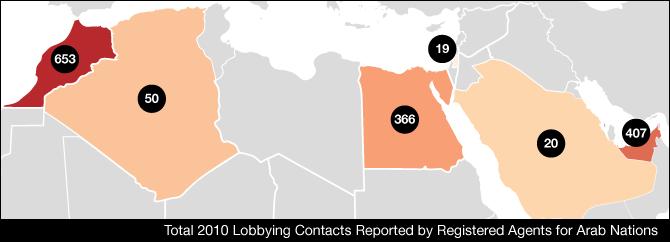
Thanks to Western Sahara, Morocco leads Arab world in number of US lobbying contracts

Read the rest at the Sunlight Foundation: http://sunlightfoundation.com/blog/2011/02/01/the-arab-worlds-2010-lobbying-contacts/

Categories
blog

WikiLeaks Cables on Western Sahara Show Role of Ideology in State Department

Over the years, as part of my academic research, I have spent many hours at the National Archives poring over diplomatic cables of the kind recently released by WikiLeaks. The only difference is that rather than being released after a 30+ year waiting period — when the principals involved are presumably dead or in retirement and the countries in question have very different governments in power — the WikiLeaks are a lot more recent, more relevant and, in some cases, more embarrassing as a result.

Categories
blog

Upsurge in repression challenges nonviolent resistance in Western Sahara

Sahrawis have engaged in protests, strikes, cultural celebrations, and other forms of civil resistance focused on such issues as educational policy, human rights, the release of political prisoners, and the right to self-determination. They have also raised the cost of occupation for the Moroccan government and increased the visibility of the Sahrawi cause.

Categories
blog

US leadership, not partisanship, desperately needed for peace in Western Sahara

[The following, coauthored with Anna Theofilopoulou, was sent to Foreign Policy magazine’s Middle East Channel blog in November 2010. It was written in response to a MEC posting by two lobbyists for Morocco (see below for links) who were responding to two earlier MEC posts by Theofilopoulou and me. MEC did not publish the response below nor did they respond to our subsequent emails. At roughly the same time, MEC did publish a response from Carne Ross, who lobbies for Polisario, the Western Sahara independence movement. – JM]

The past three days of violent confrontations between Moroccan security forces and Sahrawi protesters in the disputed Western Sahara clearly demonstrate the urgent need for the Security Council to take the issue more seriously before it spirals out of control. Initiative from the United States will be key to make this happen.

Recently we made the case for a more active US role in the Western Sahara peace process, prompting a constructive response from former US diplomats Ambassador Edward Gabriel and Mr Robert Holley, who now work as lobbyists for the Kingdom of Morocco. In their posting, Gabriel and Holley agree that a strong US role is needed but they claim that we are proposing a solution based on a referendum with independence as an option. Nowhere in our recent article or even the previous one posted in the Middle East Channel did we suggest such a thing.

Polisario and its supporters are quite capable of making the case for the independence option themselves.

There is a major point of difference between our approach and that of Gabriel and Holley: they back a partisan negotiation framework based upon Morocco’s 2007 autonomy solution. We, on the other hand, are advocating for a non-partisan approach, one that does not predetermine the meaning of sovereignty or self-determination before the parties get to the table. Essentially, we are saying that all the ingredients for a solution — final status, a referendum, power sharing, refugee repatriation, the role of Moroccan settlers, etc. — must be negotiated. With the guidance of the UN envoy, a more active US role, well-timed pressure from the UN Security Council and more imagination from the international community, we believe that Morocco and Polisario can piece together a comprehensive settlement that bridges their notions of sovereignty and self-determination.

Gabriel and Holley also present a questionable narrative of the peace process. They claim that the shift away from the integration/independence approach of the original 1991 UN Settlement Plan was initiated by the Clinton Administration and “was backed” by former Secretary of State James Baker, Personal Envoy of the Secretary-General to Western Sahara from 1997 to 2004. Those of us intimately involved with Baker’s work and internal happenings in the Western Sahara file at the United Nations beg to differ.

After watching the Western Sahara peace process stagnate for four years, the Clinton administration was more than happy to take a hands-off approach and let Baker do the heavy lifting. The Clinton White House fully backed his effort to implement the original Settlement Plan under the 1997 Houston Accords, which Baker had quickly negotiated between Morocco and Polisario. It was not until September 2000, in a meeting organized by Baker between the parties in Berlin, that the negotiations began to discuss other options besides the two choices of independence or integration. The impetus for this new direction, as everyone involved knows, was the fact that it had become abundantly clear that the referendum electorate would not favour integration with Morocco.

In Berlin, Baker asked Morocco if it would support a solution based upon some devolution of its governmental authority in Western Sahara. Though Morocco seemed willing, Rabat refused to discuss the issue of power sharing in a concrete or serious manner. This was especially the case after Baker proposed his own plan, at the prior request of the Security Council, in January 2003, a plan that included the option of independence. The US government then led effort in the UN Security Council to build support for Baker’s proposals in the summer of 2003. Only when it became clear that Morocco would no longer work with Baker did the George W. Bush administration, following the advice of Elliott Abrams, work with France and Spain to water down the Security Council’s support for the Baker Plan in April 2004.

After much coaxing, Morocco finally presented its autonomy proposal in 2007, which the Bush administration immediately deemed “serious and credible.” However, as an actual peace offer, its credibility and seriousness have to be reconciled against some hard facts that Polisario is well aware of. Morocco put it on the table because Abrams had suggested that formal US recognition of Moroccan sovereignty over Western Sahara would then be forthcoming. The State Department wisely derailed Abrams’ ambitions and helped run down the clock until the next administration. Now that Morocco is stuck with its autonomy proposal, Rabat has argued that Polisario must accept it on a take-it-or-leave-it basis.

Those of us with some historical memory can’t help but see this demand as a bit hypocritical. In 2003 and 2004, Morocco and its supporters in Washington and in the Security Council were working overtime to convince everyone that Baker could not force a solution to Western Sahara on either party — peace had to be the result of dialogue. Now Morocco wants the Security Council to force its 2007 autonomy solution, which precludes the option of independence, on Polisario.

To suggest that the negotiations over Western Sahara require such preconditions is neither true in theory nor in practice. As demonstrated in the parties’ rejections of the previous UN envoys (Morocco’s refusal to work with Baker, Polisario’s staunch refusal to accept Peter van Walsum), the neutrality of the UN Secretariat must be maintained. And since 2007, at the request of the Security Council the parties have been negotiating without any concrete preconditions. The paucity of results owes to the conflict’s apparent lack of urgency (prior to the events of the past two weeks). Western Sahara’s low strategic risk profile and negligible body count allows the UN to punt the issue every April when the UN mission comes up for renewal, passing vague and self-contradictory resolutions open to different interpretations by each party.

Just as there is a political stalemate in Western Sahara, there is also an intellectual stalemate. For too long, self-determination and sovereignty have been framed by the parties, their backers and, unfortunately, key mediators as diametrically opposed absolutes. This need not be the case. An honest broker will not accept the parties’ red lines as given but will attempt to find ways to transcend them.

In practice, self-determination and sovereignty can be seen as much more flexible than the discourse on Western Sahara often indicates. Very few countries have all of the attributes associated with claims of sovereignty; any state that has signed a treaty or entered into an agreement has already compromised its sovereignty. The realization of Morocco’s 2007 autonomy proposal would only prove the point.

In very few cases of decolonization were subject populations actually consulted in a formal referendum giving them the option of independence. By default rather than mandate, the international community has passively accepted independence as sufficient to achieve self-determination. It need not, however, been seen as necessary for self-determination. All that matters is whether or not the people of Western Sahara have the ultimate say when it comes to the final status of the territory.

About the authors

Anna Theofilopoulou covered Western Sahara and North Africa in the Department of Political Affairs of the United Nations from 1994 to 2006. She worked closely with former U.S. Secretary of State, James A. Baker, III throughout his appointment as Personal Envoy of the Secretary-General on Western Sahara.

Jacob Mundy holds a PhD from the University of Exeter’s Institute of Arab and Islamic Studies. He is coauthor of Western Sahara: War, Nationalism and Conflict Irresolution (Syracuse University Press).

Categories
blog

U.S. Middle East talks – a model for Western Sahara?

Coauthored with Anna Theofilopoulou

The recent decision by the Obama administration to invite Israel and the Palestinian Authority to engage in serious negotiations over the Middle East conflict should be instructive for those interested in resolving one that seems almost as intractable — the Western Sahara dispute. Key to this new effort in the Middle East conflict is (1) the U.S. is sponsoring and supporting the talks; (2) the U.S. has demanded that the two negotiate seriously, tackle the difficult subjects that have trounced previous attempts for resolution; and (3) the U.S. has given the two sides a one-year deadline. Though the fate of the Israel-Palestinian talks still hangs on a knife’s edge, a similar attitude on the part of United States towards the Western Sahara dispute might pave the way to a durable solution to one of Africa’s oldest conflicts.

Categories
blog

Why the UN won’t solve Western Sahara (until it becomes a crisis)