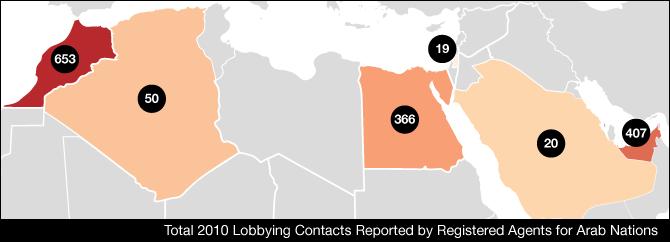
Last week, the New York Times ran an article on Arab lobbying in Washington, DC. While the context of that article focused on the current uprisings in the Middle East and North Africa, the Western Sahara conflict received an indirect and odd mention.
Those of us who have followed the politics of the Western Sahara dispute have long known about Morocco’s multi-million dollar efforts to buy favor and sew fear through its lobbying in Washington. Unable to win hearts and minds in Western Sahara, Morocco has instead opted for many years to try to win over the White House, Congress and the defense-foreign affairs establishment.
What was odd about the NYT article was the way it framed the motive for Morocco’s efforts: ‘Morocco spent more than $3 million on Washington lobbyists, much of it aimed at gaining an edge in its border dispute with Algeria, while Algeria countered by spending $600,000 itself.’
As the blogger Kal at the Moor Next Door noted in a tweet, ‘Is Morocco also spending money on the New York Times? http://is.gd/1mErKT “border dispute w Algeria”? or, um, Western Sahara’.
While it is the case that there are some border issues between Morocco and Algeria (e.g., the land border has been closed for over a decade), there is no formal border dispute with Algeria. The international border between Morocco and Algeria is essentially recognized by both countries.
The ‘border dispute’ that motivates Morocco’s intense lobbying efforts in Washington, DC, is the dispute between Morocco and the rest of the international community over the territory of Western Sahara, which the United Nations considers a non-self-governing territory (read: a colony) still under Spanish de jure dominion.
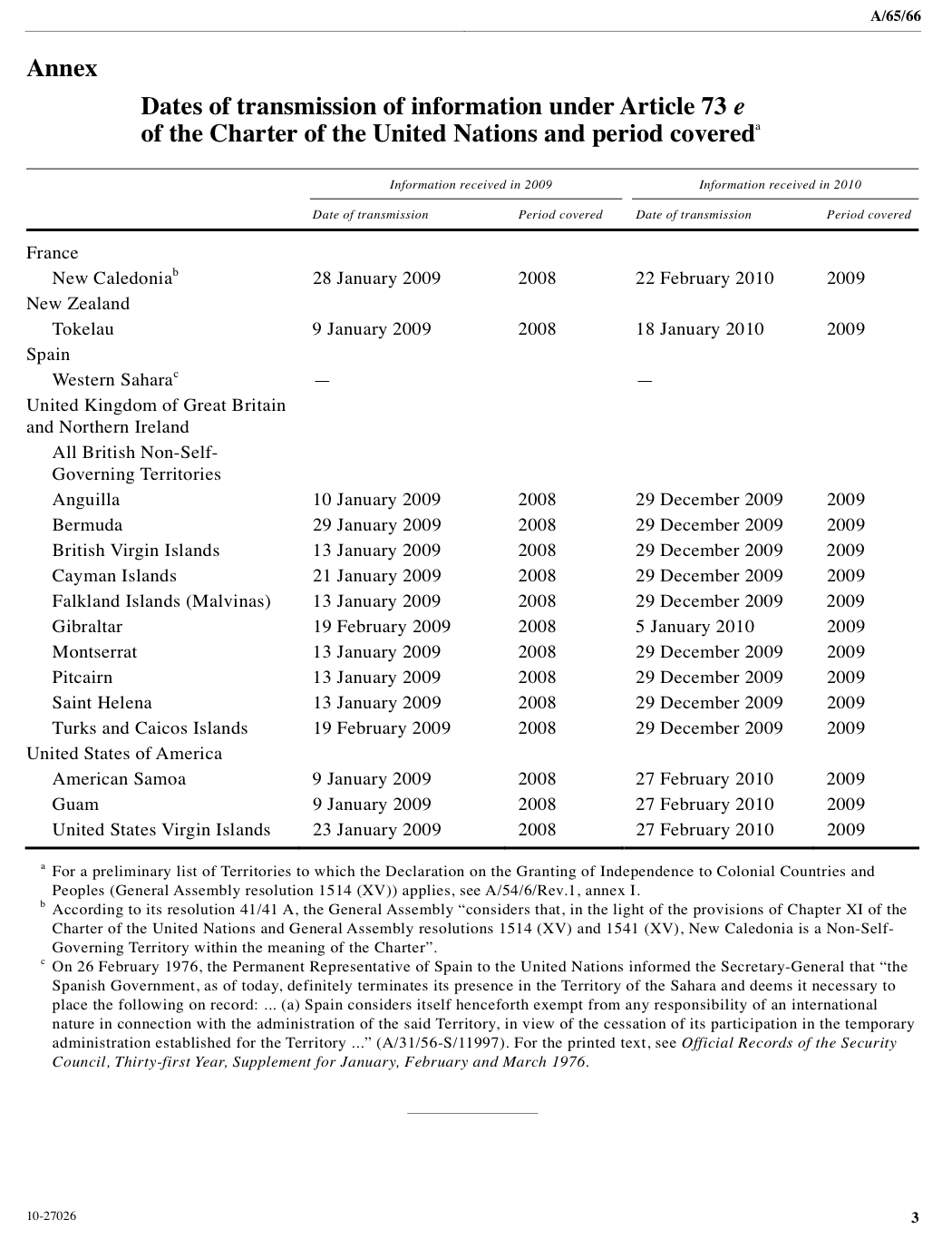
In recent months, the NYT has had a difficult time grasping the fundamental geography of the Western Sahara conflict. Three times the US paper of record has described the Western Sahara conflict as ‘separatist’ or a case of ‘separatism’, often equating the issue with the recent secession of Southern Sudan (here, here and here). The last of the three elicited interesting letters from Human Rights Watch and Polisario.
Describing the Western Sahara conflict as a matter of separatism or as a separatist issue implies that Morocco has sovereignty or some kind of international legal authority over Western Sahara, which is clearly not the case.
In response to these articles, I wrote to the NYT’s ombudsman to ask what is their definition of separatism. This is what I got on 12 January 2011:
Dr. Mundy:
Thank you for writing and pointing this out to us. I’ve forwarded your email along to The Times editor who oversees corrections to see if this will warrant a correction. We’ve heard from a few other readers on this as well, so The Times is aware of this right now. Once again, thanks for writing. We appreciate your help.
Best,
Joseph Burgess
Office of the Public Editor
The New York Times
public@nytimes.com
On 24 January, I sent a follow up email to see if anything has been determined but no response yet.
Given the fact that the NYT can’t quite get the macro-geography of Western Sahara right, no surprise that two of its reporters, J. David Goodman and Souad Mekhennet, produced an alarmist article that made a stunningly basic mistake of Western Sahara micro-geography.
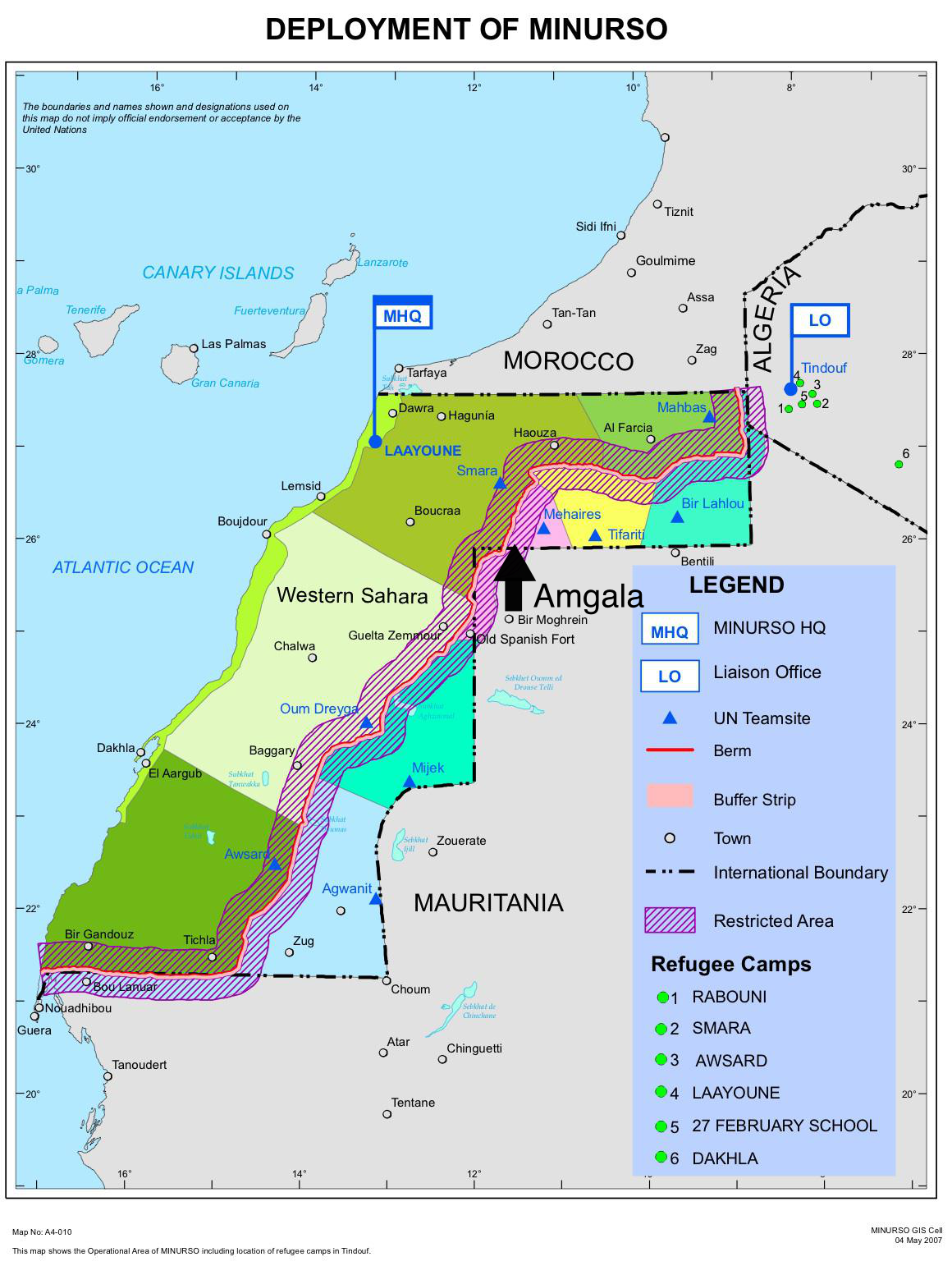
Its opening paragraph led with this frightening claim: ‘The Moroccan government arrested 27 people accused of operating a terrorist cell in Western Sahara led by a member of the local branch of Al Qaeda, officials said Wednesday’. Moroccan authorities, they reported, found arms caches in ‘three sites around Amgala’. (Reuters fell for it too.)
Two problems: The immediate problem is that Amgala is not under Moroccan control but rests within the buffer area east of Morocco’s defensive wall in Western Sahara. This area is strictly patrolled by the UN referendum mission in Western Sahara. Under the conditions of the cease-fire initiated by the United Nations in 1991, Morocco is prohibited from entering this buffer; Moroccan forces have not been able to enter the area of Amgala for twenty years. In short, someone is either stretching the meaning of ‘around’ (i.e., ‘around Amgala’) or there is something else going on. Minimally, one would expect the NYT reporters to pose this basic question to the UN mission. Instead, Goodman and Mekhennet seem satisfied repeating the Moroccan government view without any balancing opinions.
And this gets to the second problem: Given the fact that UN peacekeepers have been present in Western Sahara since the early 1990s, conducting constant patrols to monitor Moroccan and Polisario forces along the armistice line, and the fact that Morocco has some 100,000 reported troops in Western Sahara, how is it that AQIM seems to have such free reign in the Moroccan controlled Western Sahara?
In the wake of the massive demonstrations in Western Sahara in November, it is difficult not to think that Morocco simply wanted to scare Washington into thinking that Al-Qaida or AQIM had set up shop in the disputed Western Sahara.
Indeed, the eventual ‘reality’ of the Amgala affair was perhaps more telling than the NYT’s fiction. On 12 January, Reuters reported, ‘Morocco said five of its soldiers face trial for taking bribes from people smuggling weapons into an area of the disputed Western Sahara for a cell linked to al Qaeda in the Islamic Maghreb (AQIM).’
Did Goodman and Mekhennet write a follow up to their original piece? You must be joking.
But either way, Morocco wins: in the original narrative reported by the NYT, Polisario, through geographic insinuation, is tied to AQIM, and so Morocco seems like the side for Washington to back. In the revised narrative reported by Reuters, it seems that there are elements within Morocco’s military that are unknowingly aiding AQIM, which suggests that the US should redouble its cooperation with the Moroccan military to prevent its radicalization. How convenient that either narrative only supports one policy choice: choosing Morocco’s internal stability over the regional instability created by the Western Sahara conflict.